Internet Bill Collection: How ISPs Cut Late Payments
By BillKaro TeamPublished 9 min read
Internet bill collection is the monthly work an ISP or cable operator does to get every subscriber's bill paid: issuing bills on a fixed date, reminding late payers, recording payments and deciding when to suspend a connection. Most providers cut late payments with one clear bill, a set reminder schedule, accurate payment records and a way to pay from the bank app.
This guide is for the people who collect the money at a local ISP, a fibre or cable operator, or a reseller: owners, accounts staff and recovery teams. It is not about how a subscriber pays a bill. It covers why subscribers fall behind, the billing cycle that keeps collections steady, how to handle suspensions fairly, and what changes when bills can be paid through 1Bill.
Why do internet subscribers pay their bills late?
Internet subscribers usually pay late because paying is inconvenient or the bill is unclear, not because they plan to stop paying. For a small ISP, the late list each month is mostly the same few habits repeating.
- Cash collection depends on a visit. If a recovery boy collects at the door, or the subscriber must visit your office, the bill waits until someone is home or free.
- The bill arrives late or not at all. A bill that turns up after the due date, or only as a verbal reminder from a field worker, starts the month late.
- The amount is a surprise. Package changes, a one-time installation charge or an arrear on the same bill without explanation make people hold back the whole amount.
- Service complaints. A subscriber who had outages this month often delays payment as a protest.
- Records disagree. When your register says unpaid and the subscriber has a receipt, every follow-up becomes an argument.
Remove the first four causes and the true defaulters become a short list you can call one by one. The fifth cause, wrong records, is the most damaging, because it hits the subscribers who did pay.
How big is the subscriber base that needs billing every month?
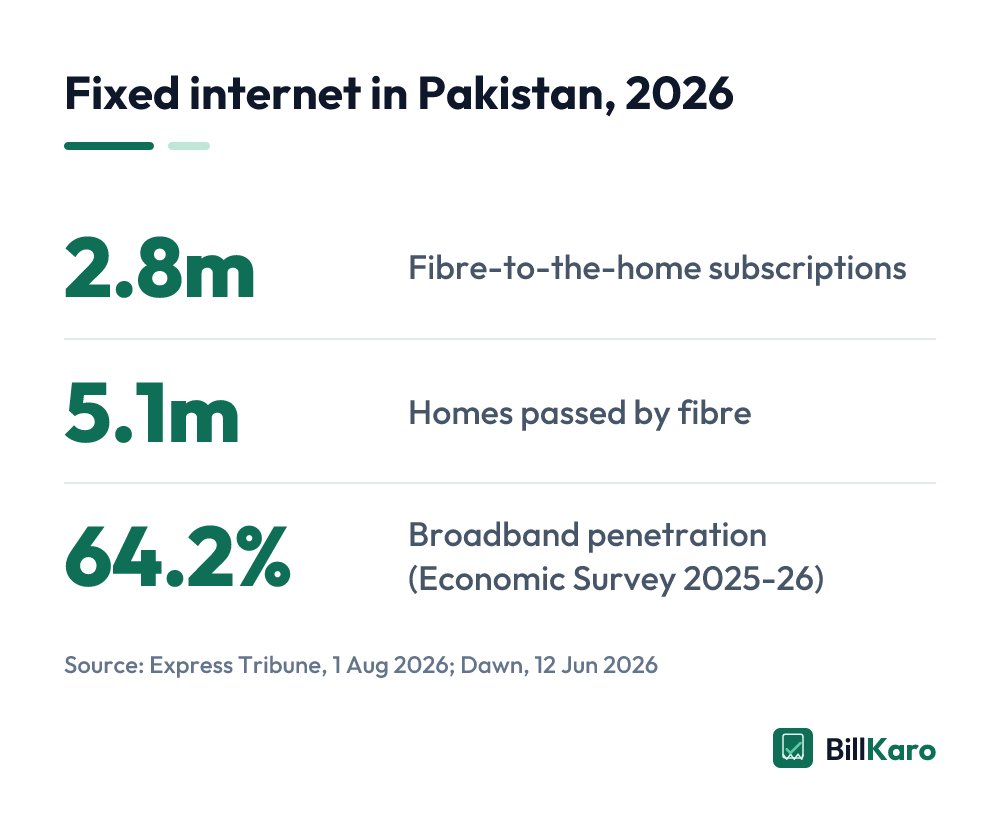
Fixed internet in Pakistan is growing, so the monthly billing load for providers is growing with it. Fibre-to-the-home subscriptions reached 2.8 million, with 5.1 million homes passed by fibre (Express Tribune, 1 August 2026). The government aims for 10 million households on wired broadband, while mobile broadband subscriptions stand at 161.7 million (Arab News, 23 October 2026). Overall broadband penetration rose to 64.2% from 32.6% in 2019, according to the Economic Survey 2025-26 (Dawn, 12 June 2026).
For an operator, every new connection is another bill each month. A routine that works for 300 subscribers on a register often breaks at 1,500.
What should a monthly internet bill show?
A monthly internet bill should let the subscriber check it in under a minute and pay without calling you. Each missing field turns into a phone call or a delayed payment.
| Field | Why it matters |
|---|---|
| Subscriber name, connection ID and area | Ties the payment to the right connection |
| Bill number and billing month | Stops duplicate and missing payments |
| Package name and monthly charge | The subscriber sees what they pay for |
| One-time charges (installation, router, relocation) on their own line | No surprise inside the package price |
| Previous balance and any late payment charge, shown separately | Removes the "what is this arrear?" call |
| Due date and suspension date | Sets expectations before you act |
| How to pay | One clear method, not a list of exceptions |
| Complaint or helpline contact | Service issues reach support, not the recovery team |
For the fields a business invoice in Pakistan generally carries, including tax details, see our guide to invoice format in Pakistan.
Tip: Show the suspension date on the bill itself. A subscriber who knows the exact date a connection pauses pays before it; one who only hears "soon" waits for the cut-off.
What billing cycle keeps internet collections on time?
A fixed monthly cycle keeps collections on time: bill on the same date, remind on set days, review the late list on a set day, and suspend only by the written rule. Subscribers plan around dates they can predict, and your staff stop chasing by memory.
- Day 1: issue every bill. Generate all bills in one run, with a check that nobody was missed or billed twice.
- Day 1: send the bill. Email it or share it the way the subscriber chose at sign-up, with the due date and how to pay.
- Due date minus 2 days: friendly reminder. Short, polite, with the amount and how to pay.
- Due date plus 3 days: second reminder. Name the suspension date.
- Due date plus 7 days: call the late list. Ask about service issues before talking about money.
- Suspension date: pause by rule. Only for subscribers still unpaid after checking the latest payments.
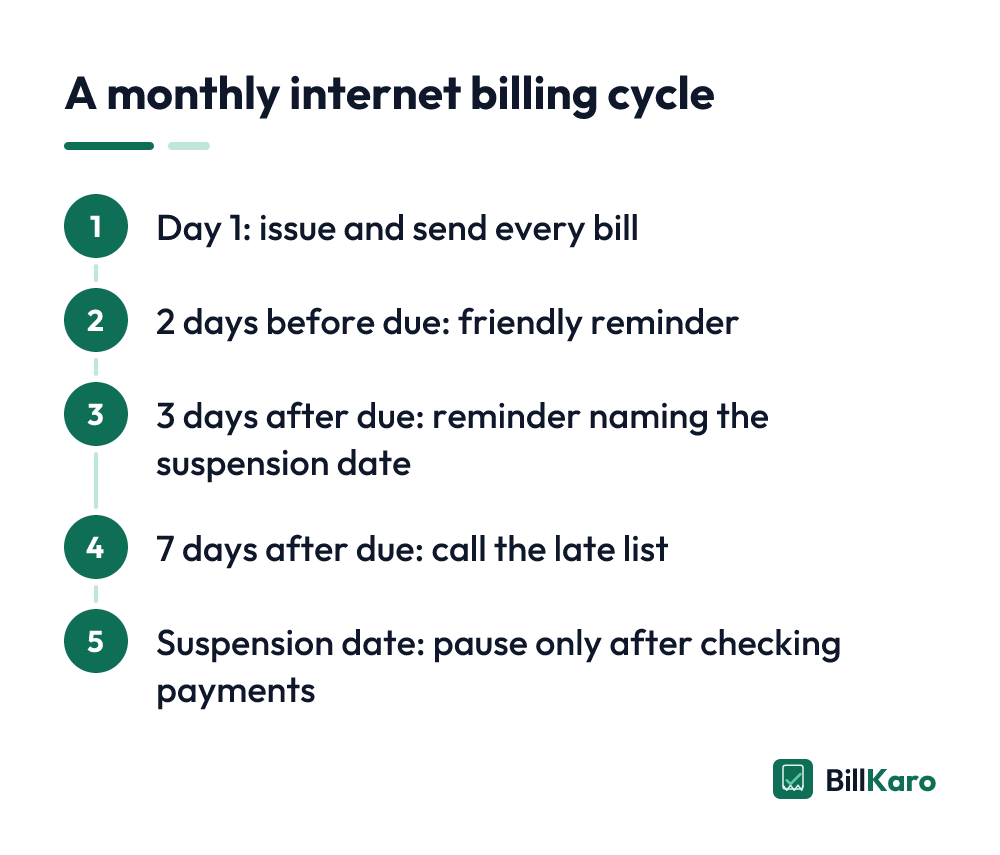
Your own dates may differ. What matters is that they are written down, the same every month, and known to subscribers.
How should an ISP handle suspension and late fees fairly?
An ISP should suspend a connection only by a written rule, and only after confirming the latest payments. Suspending someone who has already paid is the fastest way to lose a subscriber, and it can cost more than the bill.
Subscribers expect service in return for paying on time. In June 2026, a Karachi consumer court ordered two ISPs to pay Rs50,000 to a subscriber who faced repeated disruptions and disconnections despite paying his bills on time (Dawn, 20 June 2026). That case was about service quality, but the lesson for recovery teams is the same: a paid subscriber must never be treated as a defaulter.
Late payment charges are common in telecom billing. When Jazz added one for postpaid customers, it was 5% of the bill or Rs50, whichever was higher, and the report noted that utilities had long charged about 10% (Profit, 17 October 2022). If you add one:
- state it in your subscriber terms and on every bill;
- show it as its own line, not folded into the package price;
- apply it the same way to everyone, and record any waiver with a reason.
Note: Check your licence conditions and your subscriber agreement before setting suspension or late fee rules. This guide is general practice, not legal advice.
How does 1Bill help ISPs collect internet bills?
1Bill lets subscribers pay an ISP's bill from their bank's mobile app or internet banking, so payment no longer depends on a visit or office hours. 1Bill is run by 1LINK, and 1LINK names "Utilities, Telecommunication & ISPs, Government bodies and Education institutions" among its billers (1LINK).
BillKaro is a 1Bill payment-collection integration for Pakistani businesses: bills from your own system (by API or Excel/CSV upload) or from BillKaro's invoicing software can be paid through 1Bill from the customer's bank app or internet banking. Tech Vision Solvix, the company behind BillKaro, is a 1LINK partner; 1LINK runs 1Bill. When a subscriber pays, the payment status syncs back, so the bill is marked paid automatically.
For an ISP, there are three ways in:
| Your situation | How bills reach 1Bill |
|---|---|
| You have ISP billing software | Connect it to BillKaro by API |
| You export bills from your system or Excel | Upload the month's bills as an Excel or CSV file |
| You bill from a register or spreadsheet | Issue the bills in BillKaro's invoicing software |
The step-by-step version is in how to create a 1Bill invoice, and the ISP-specific page is ISP billing software.
1Bill collection has a one-time integration fee for your business, then a charge per invoice paid through 1Bill, by the bill amount, the same at any volume. See the integration fee and the per-invoice prices on the pricing page. You decide who covers the per-invoice charge: absorb it, or pass it to your subscriber.
What else helps an ISP's accounts team?
The rest of the work is keeping records that match reality and knowing who to chase first. If you bill from BillKaro's invoicing software, these features from the product cover it:
- Monthly billing in one run. Each subscriber carries a billing model (flat monthly, per unit, tiered, quarterly or annual), and BillKaro creates the month's invoices with a preview before you commit.
- Reminders by days after the due date. Each step has its own email subject and message, and a report shows which steps worked.
- Ageing buckets. Current, 1-30, 31-60, 61-90 and over 90 days, so the team calls the oldest debts first.
- Pause billing. Stop billing a subscriber up to a date without closing their account.
- Cash recorded by hand. Payments collected at your office or by staff are recorded in full or in part, with a PDF receipt.
Bills paid through 1Bill are marked paid automatically, so the cash and cheque payments are the only ones your team records.
Other providers also offer 1Bill collection. For example, ezbill.pk has a page for ISPs and cable operators and offers a payment API, and wasooli.online focuses on recurring bills for societies, gyms and similar businesses. Compare how each connects to your current system, how payment status comes back and what the full cost is before you choose.
For a similar plan written for housing societies, see society maintenance defaulters.
Frequently asked questions
What is internet bill collection?
Internet bill collection is how an ISP or cable operator gets each subscriber's monthly bill paid. It covers issuing bills, sending reminders, recording payments and handling late or suspended connections. A fixed monthly cycle and a bank-app payment option make it far easier to manage.
How can an ISP reduce late payments?
Bill on the same date every month, show the due date and suspension date on the bill, send reminders on set days, and let subscribers pay from their bank's mobile app or internet banking. Check the latest payments before suspending anyone.
Can subscribers pay an ISP bill through 1Bill?
Yes, if the ISP collects through 1Bill. With BillKaro, subscribers pay from their bank's mobile app or internet banking, and the payment status syncs back so the bill is marked paid automatically.
Can we keep our current ISP billing system?
Yes. Connect it to BillKaro by API, or upload each month's bills as an Excel or CSV file. Subscribers pay through 1Bill, and the payment status syncs back to you.
What does 1Bill collection cost an ISP with BillKaro?
There is a one-time integration fee per business, then a charge per invoice paid through 1Bill, by the bill amount. The amounts are on the BillKaro pricing page, and you decide whether to absorb the per-invoice charge or pass it to subscribers.
Ready to stop chasing internet bills door to door? See how BillKaro works for ISPs and cable operators, or request a demo on WhatsApp and we will walk you through connecting your subscriber bills to 1Bill.