Invoice Format in Pakistan: What Your Invoice Must Show
By BillKaro TeamPublished 10 min read
A correct invoice format in Pakistan has a clear "Invoice" or "Tax Invoice" heading, your business name, address and NTN, the client's name, address and NTN (or CNIC), a unique invoice number, the date, a description of each item, the amount before tax, any tax rate and amount, the total in PKR, and payment terms with your bank details.
That list covers most service businesses. If you are registered for sales tax, the rules ask for more, and for many registered businesses the invoice now has to be generated and reported electronically. This guide separates the two cases, gives a field-by-field checklist, and shows the mistakes that delay payment.
What is the standard invoice format in Pakistan?
The standard invoice format in Pakistan answers five questions: who is billing, who is paying, what was supplied, how much, and how to pay. A clean layout puts these in five blocks, top to bottom.
- Header: the word "Invoice" (or "Tax Invoice" if you are a registered person issuing one), your logo, business name, address, phone, email and NTN.
- Bill to: the client's legal name, address, NTN or CNIC, and a contact person.
- Invoice details: invoice number, invoice date, due date, and the period the invoice covers (for example "Services for October 2026").
- Line items: description, quantity or hours, rate, amount, then subtotal, discount, tax and total.
- Payment section: bank name, account title, IBAN, payment terms, and notes such as "Please quote the invoice number in your transfer."
Most guides that rank for this search, such as the InvoiceQuickly Pakistan template and the Refrens invoice generator, list the same core fields. What they mostly skip is the difference between an ordinary commercial invoice and a sales tax invoice, which is where Pakistani businesses get caught.
Which fields must every business invoice include?
Every business invoice should include the fields below, whether or not you are registered for sales tax. The table also shows why each field matters when you are trying to get paid.
| Field | Example | Why it matters |
|---|---|---|
| Invoice number | INV-2026-11-0042 | Unique and in sequence; clients and auditors match payments to it |
| Invoice date and due date | 20 Nov 2026, due 5 Dec 2026 | Starts the credit period and your overdue count |
| Your name, address, NTN | Registered business name | Client's accounts team needs it for their records and tax deductions |
| Client name, address, NTN or CNIC | Client's legal entity, not a brand name | Wrong entity names are a common reason invoices get sent back |
| Description of service | "Website maintenance, October 2026" | Specific wording avoids queries |
| Quantity, rate, amount | 1 month x Rs. 50,000 | Lets the client check the maths |
| Discount and tax | Shown as separate lines | Tax must be visible, not buried in the price |
| Total in PKR | Figures and, ideally, in words | Avoids disputes on large amounts |
| Payment details | Bank, account title, IBAN | The fewer steps to pay, the faster you are paid |
| Terms and notes | "Payable within 15 days" | Sets expectations before the due date |
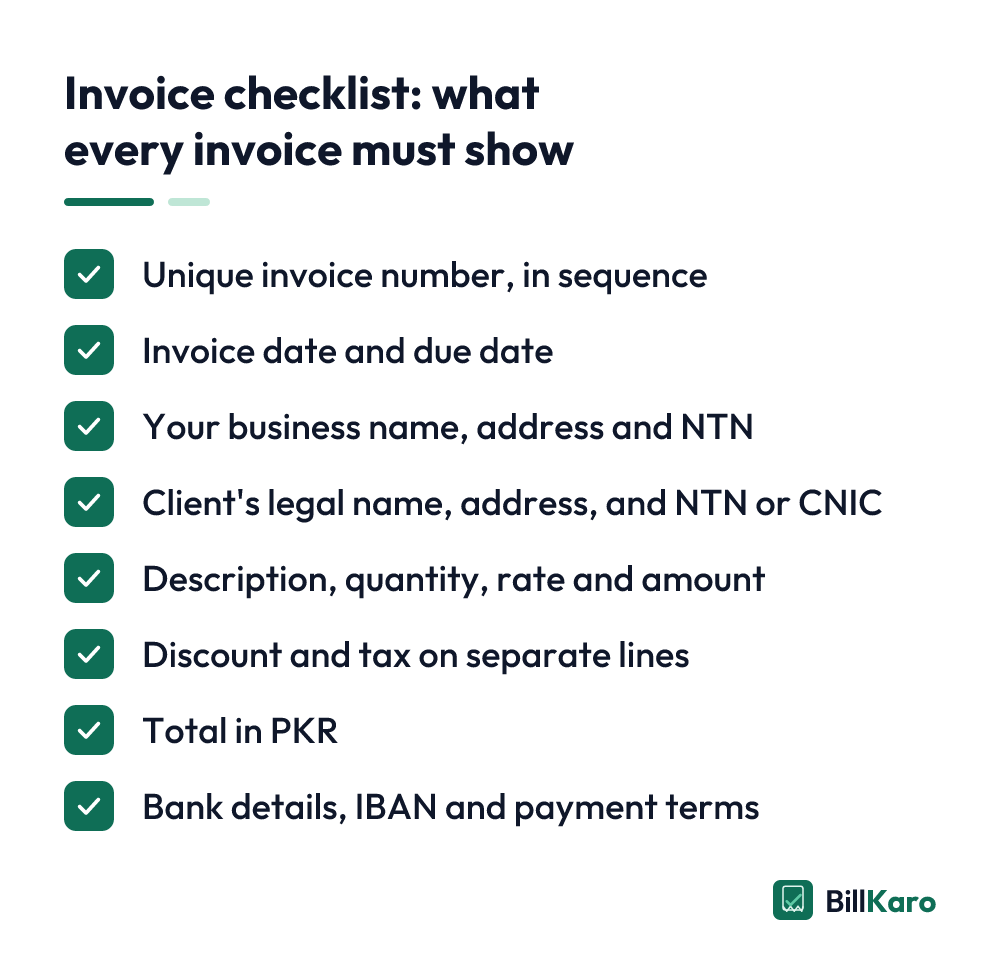
Tip: Use the client's legal name exactly as it appears on their NTN record. Corporate accounts teams often reject invoices addressed to a trading name, and you lose a week before anyone tells you.
How is a sales tax invoice different from a normal invoice?
A sales tax invoice is a legal document that only a registered person can issue, and it must carry specific particulars set by law. A normal commercial invoice is simply a request for payment.
For goods, the contents of a tax invoice are set by section 23 of the Sales Tax Act, 1990. The FBR's own FAQ on electronic invoicing quotes section 23(1)(b): when a manufacturer or importer supplies an unregistered distributor, "the tax invoice shall contain the NIC or NTN of such unregistered distributors." The same FAQ says a debit or credit note is issued when a supply changes, rather than editing the original invoice.
The InvoiceQuickly guide, which summarises the current rules and was checked on 27 October 2026, lists what a registered person's invoice adds on top of the basic fields:
- both parties' registration numbers and the tax period;
- HS code and unit of measurement for each line;
- sales tax rate and amount, plus any tax withheld, extra tax or further tax;
- federal excise duty, discounts, and the SRO and serial number where a reduced rate or exemption applies;
- for electronically integrated businesses, the unique FBR invoice number and a QR code.
The same page states plainly that unregistered freelancers and businesses issue ordinary invoices without sales tax. If you are not registered, do not print "Tax Invoice" or charge sales tax.
What do service businesses need to know about provincial sales tax?
Most services in Pakistan are taxed by the provinces, not the FBR. Service providers register with their provincial authority: the Punjab Revenue Authority (PRA), the Sindh Revenue Board (SRB), the Khyber Pakhtunkhwa Revenue Authority (KPRA) or the Balochistan Revenue Authority (BRA), as both the InvoiceQuickly guide and Refrens note.
Each authority sets its own rates and invoice rules, so a software house in Lahore and one in Karachi may print slightly different tax lines. If you are registered with a provincial authority, show:
- your provincial registration number next to your NTN;
- the provincial tax rate and amount as a separate line;
- the total including tax.
Islamabad is a special case. Services in the Islamabad Capital Territory are taxed under a federal ordinance, and S.R.O. 1666(I)/2026, dated 29 September 2026, extends the electronic invoicing and integration rules to services taxable under the Islamabad Capital Territory (Tax on Services) Ordinance, 2001. According to that summary, if sales tax, excise duty and services tax apply to one transaction, one electronic invoice with each tax shown separately is enough. Islamabad service providers who were not integrated before should check whether they now have to be.
Note: This post explains invoice layout, not tax advice. Rates, registration thresholds and exemptions change with each budget, so confirm your own position with your tax adviser or your provincial authority.
Do I need an electronic invoice from FBR's system?
If you are a sales tax registered person under the federal law, very likely yes. The FBR's electronic invoicing FAQ says electronic invoicing "is mandatory for all the Corporate registered and Non-Corporate registered persons", and that the invoicing system must be connected "through a licensed integrator having a valid FBR License for Integration". It also says a paper invoice that is later scanned does not count as an electronic invoice.
The rules behind this were rewritten by S.R.O. 69(I)/2025 of 29 January 2025. EY's summary says integrated invoices must "include digital signatures and QR codes based on the unique invoice number assigned by the Board", and that PRAL is a licensed integrator offering the service free, while other licensees may charge.
For an unregistered service business, a freelancer or a consultant billing professional fees, none of this applies. Your job is a clear, consistent commercial invoice that the client's accounts team can process without questions.
What are the most common invoice mistakes in Pakistan?
The most common invoice mistakes are small details that give a client's accounts team a reason to hold payment. Watch for these:
- No NTN, or the wrong one. Large clients deduct withholding tax and need your NTN to issue a deduction certificate.
- Reusing or skipping invoice numbers. Numbers must be unique; gaps raise questions in audits.
- Vague descriptions. "Services" invites a query. "Social media management, October 2026, 20 posts" does not.
- Tax mixed into the price. Show the amount before tax, the tax line and the total separately.
- Missing due date. Without one, "overdue" means nothing and follow-ups feel personal.
- Editing a sent invoice. Issue a credit note instead, so both sides keep the same record.
- No bank details. Every extra message asking for an IBAN adds days.
- Withholding tax not tracked. When a client pays Rs. 95,000 against a Rs. 100,000 invoice because tax was deducted at source, record the deduction and collect the certificate or CPR, or your receivables will never reconcile.
Should you use an Excel template or invoicing software?
An Excel or Word template is fine for a handful of invoices a month. It becomes a problem when you bill the same clients every month, because numbering, due dates, reminders and payment matching all depend on someone remembering.
| Need | Excel or Word template | Invoicing software |
|---|---|---|
| Unique invoice numbers | Typed by hand | Generated automatically |
| Monthly invoices for regular clients | Copied and edited each month | Created from each client's billing set-up |
| Partial payments and balances | Separate sheet, easy to miss | Recorded against the invoice |
| Withholding tax deductions | Rarely tracked | Recorded with certificate details |
| Overdue follow-ups | Manual | Reminder steps by days overdue |
BillKaro is invoicing and recurring billing software for Pakistani businesses that bill the same clients again and again. It prints your NTN and your client's NTN on every branded PDF invoice, numbers invoices automatically from a template you set (with year, month and sequence), adds your bank payment details, and emails the PDF to the client with CC addresses. Recurring invoices can be generated monthly, quarterly, semi-annually or annually, partial payments are recorded against each invoice, credit notes handle corrections, and withholding tax a client deducts can be recorded with its section, certificate or CPR number and Pakistan tax year. BillKaro uses a plain tax percentage on the invoice; it does not connect to the FBR's electronic invoicing system. See the full feature list and plans.
Your customers can also pay BillKaro invoices through 1Bill from their bank's mobile app or internet banking, and the invoice is marked paid automatically. See how our 1LINK partnership works.
Frequently asked questions
What is the basic invoice format in Pakistan?
A basic invoice in Pakistan shows the word "Invoice", your business name, address and NTN, the client's details, a unique invoice number, the date and due date, line items with amounts, any tax shown separately, the total in PKR, and your bank details. This works for unregistered businesses and freelancers.
Is NTN mandatory on an invoice in Pakistan?
For a sales tax invoice, registration numbers are part of the required particulars, and the FBR says a manufacturer or importer supplying an unregistered distributor must show the buyer's NTN or CNIC. For an ordinary commercial invoice it is good practice, because clients need your NTN to deduct withholding tax and issue certificates.
Can I issue a tax invoice if I am not registered for sales tax?
No. Only registered persons, or those paying retail tax, may issue sales tax invoices. An unregistered business should issue an ordinary invoice without charging sales tax.
What payment terms should I put on an invoice?
State a due date, not just "on receipt". Many service businesses use 7, 15 or 30 days. Whatever you choose, keep it the same for each client and follow up on the day after the due date.
How do I correct an invoice that was already sent?
Do not edit the original. Issue a credit note (or a debit note if the amount increases) that refers to the original invoice number, as the FBR's electronic invoicing FAQ describes for changed supplies.
Make every invoice correct the first time
A good invoice format in Pakistan is less about design and more about consistency: the same fields, the right NTNs, clear tax lines and an easy way to pay. If you bill regular clients every month and want numbering, recurring invoices, payments and withholding tax tracked in one place, request a BillKaro demo on WhatsApp and we will show you how your invoices would look.