Society Maintenance Defaulters: How to Collect Dues on Time
By BillKaro TeamPublished 10 min read
Society maintenance defaulters are residents who stop paying their monthly maintenance, security or service charges on time. Most Pakistani societies can bring their numbers down with four habits: one clear bill per unit each month, a fixed reminder schedule, an up-to-date record of who owes what, and a payment method residents can use from their bank app.
This guide is for the people who run collections: a society's management committee, treasurer, accounts office or building manager. It covers why residents fall behind, how to track them, the order in which to escalate, and how paying through 1Bill changes the daily work. It is general guidance, not legal advice; your society's bylaws decide what penalties you can apply.
Why do residents become maintenance defaulters?
Residents usually become defaulters for ordinary reasons, not because they refuse to pay. In most societies, a large share of late payments comes from people who forgot, could not get to the office during working hours, or are waiting for an answer to a question about their bill.
The common causes are:
- Paying is inconvenient. If the only options are cash or a cheque at the society office, anyone who works the same hours as the office is late by default.
- The bill is unclear. A resident who cannot see what the charge covers, or sees an arrear they do not recognise, holds back the whole amount.
- No reminder arrives. Without a reminder close to the due date, the bill slips behind school fees, utility bills and rent.
- Trust in spending is low. Residents who think the funds are not spent well are slower to pay. An ARY News explainer on maintenance fee disputes notes that owners can ask for a breakdown of fees collected and spent, and for expense sheets and supporting documents.
- Records disagree. When the office's register and the resident's bank statement do not match, every follow-up call turns into an argument.
Fix the causes on this list and the hard core of real defaulters becomes small enough to handle one by one.
How big a problem is non-payment for a society?
Non-payment matters because maintenance money pays for the services residents notice first: guards, sweepers, street lights, water pumps and repairs. When collections fall, the committee either cuts services or chases the residents who already pay, and both make the next month's collection harder.
Unpaid dues also flow upwards. In Lahore, the Water and Sanitation Agency listed at least 74 housing developments as defaulters for its sewerage and drainage services, with about PKR 1.5 billion outstanding, and planned notices, disconnections and a stop on map approvals (Zameen News, December 2021). In Islamabad, a magistrate issued arrest warrants in May 2026 for the operators of 16 housing societies over the Capital Development Authority's pending claim of Rs1.8 billion; one society said the CDA's notice had been suspended by the Islamabad High Court (Dawn, 11 May 2026). Those disputes are about developers and authorities rather than residents, but they show the same chain: a society that cannot collect from residents struggles to pay its own bills.
What should a maintenance bill show?
A maintenance bill should let a resident check it in under a minute. If they can, they are more likely to pay it straight away and less likely to visit the office with questions.
| Field | Why it matters |
|---|---|
| House, plot or flat number and owner's name | Ties the payment to the right unit |
| Bill number and billing month | Stops duplicate and missing payments |
| Each charge on its own line (maintenance, security, other services) | Residents can see what they are paying for |
| Previous balance and any late payment charge, shown separately | Removes the "what is this arrear?" call |
| Due date | Sets the start of your reminder schedule |
| How to pay | One clear method, not a list of exceptions |
| Office contact for questions | Questions get answered before the due date, not after it |
For more on the fields a business invoice in Pakistan carries, see our guide to invoice format in Pakistan.
Tip: Bill on the same day every month and keep the due date the same too. Residents plan around a fixed date, and your reminders can run on a fixed schedule.
How should a society track who owes and for how long?
Track defaulters by age of debt, not by a single "unpaid" list. A resident who is 10 days late needs a reminder; a resident who is 100 days late needs a meeting or a formal notice. Mixing the two wastes the committee's time.
Use five ageing buckets, the same ones accountants use for any receivable:
- Current: billed this month, not yet due.
- 1-30 days overdue: usually forgetful payers; a reminder is enough.
- 31-60 days overdue: a second reminder and a phone call from the office.
- 61-90 days overdue: a written notice from the committee.
- Over 90 days: action under the society's bylaws.
Keep a statement for every unit that shows each bill, each payment and the running balance. When a resident disputes an amount, the statement settles it in minutes. It also lets the committee report collection figures at its meetings without rebuilding a spreadsheet each time.
What is a fair escalation plan for defaulters?
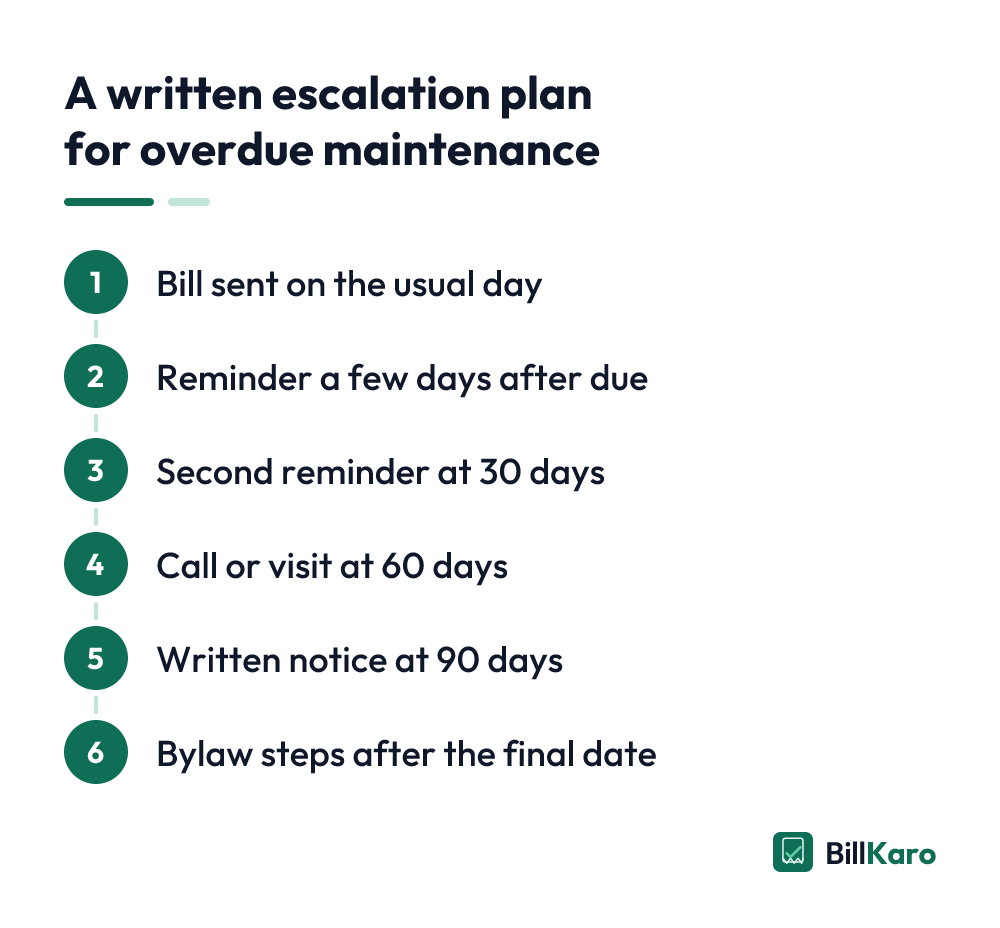
A fair escalation plan is written down, approved by the committee, shared with every resident in advance and applied the same way to everyone. Residents accept firm steps more readily when they knew about them before the bill was late.
A typical sequence:
- Before the due date: the bill, sent on the usual day.
- A few days after the due date: a polite reminder with the amount and the bill number.
- About 30 days late: a second reminder that mentions the next step.
- About 60 days late: a call or visit from the office to hear any problem with the bill.
- About 90 days late: a written notice from the committee with a final date.
- After the final date: the steps your bylaws allow.
What happens after the final notice depends on your bylaws. As an example, an Islamabad cooperative society, CDECHS, gave defaulters one month from a newspaper notice to clear dues and warned of legal action under its bylaws, fines and cancellation of plots (Zameen News, January 2021). For cooperative societies, the ARY explainer says residents' complaints about how a society handles fees can go to the Registrar of Cooperative Societies. Before you add penalties, check your bylaws with a lawyer.
Note: Cutting off a shared service such as water to a single house can start a bigger dispute than the unpaid bill. Take advice before using it.
How does paying through 1Bill reduce defaulters?
Paying through 1Bill reduces defaulters by removing the two biggest excuses: "I could not come to the office" and "I paid, check your records". Residents pay the society's bill from their bank's mobile app or internet banking, and the payment comes back to the society as a status against that bill.
1Bill is the bill payment service run by 1LINK, Pakistan's interbank switch. Housing billers already use it: 1LINK's biller list for September 2026 includes Defence Officers Housing Authority Karachi and the Federal Government Employees Housing Authority, among others.
Here is how the main ways of paying compare for the accounts office:
| How residents pay | What the office has to do |
|---|---|
| Cash at the office | Count, issue a receipt, deposit, record by hand |
| Cheque | Record, deposit, wait for clearing, chase bounced cheques |
| Bank transfer to the society's account | Find the payment on the statement and guess which unit sent it |
| 1Bill from the bank app or internet banking | Payment status syncs back against the unit's bill |
The last row is what changes the defaulter list. When payments match themselves to the right unit, the list is correct every morning, and nobody gets a reminder for a bill they already paid.
How does BillKaro help a society collect maintenance?
BillKaro is a 1Bill payment-collection integration for Pakistani businesses: bills from your own system (by API or Excel/CSV upload) or from BillKaro's invoicing software can be paid through 1Bill from the customer's bank app or internet banking.
For a society, that works in one of two ways:
- You already have society software. Keep it. Connect it to BillKaro by API, or upload the month's maintenance bills as an Excel or CSV file. Residents pay through 1Bill and the payment status syncs back.
- You do not have software. Use BillKaro's invoicing software. Each house or flat is a client with a flat monthly amount, and BillKaro creates the month's bills for every unit, with a preview before you commit.
BillKaro's invoicing software also covers the tracking and follow-up described above:
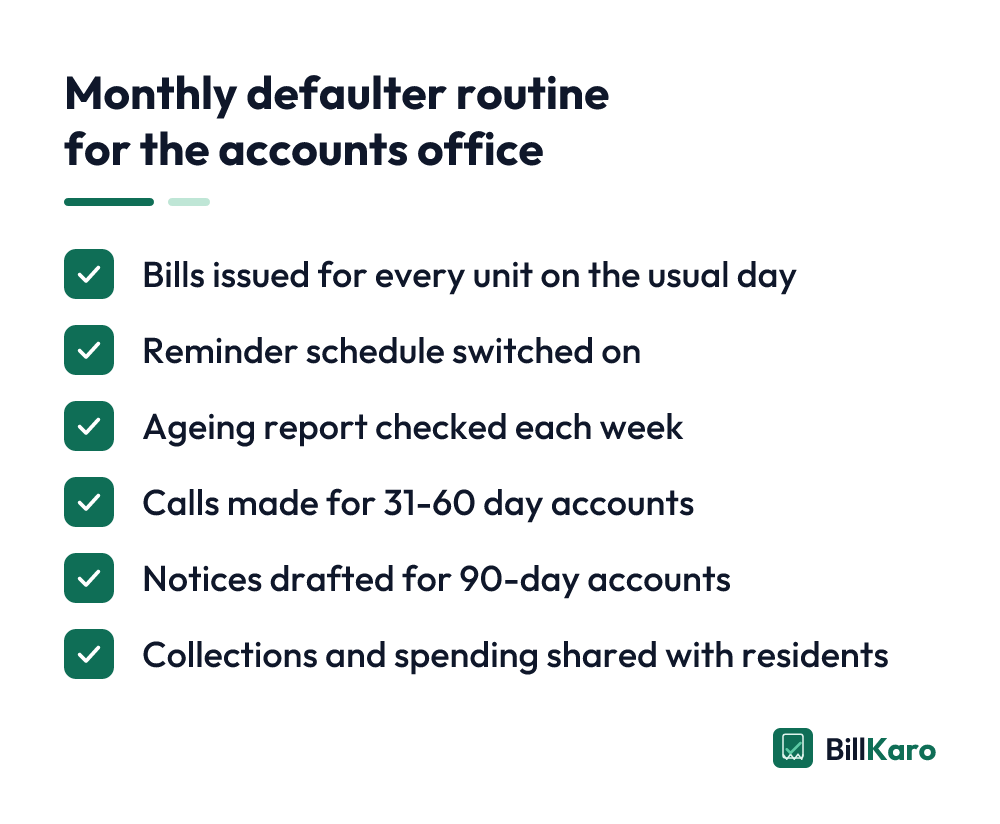
- reminder emails set by days after the due date, each with its own message, plus a report on which reminders got people to pay (reminders go out by email);
- ageing buckets of current, 1-30, 31-60, 61-90 and over 90 days, with outstanding and overdue reports;
- a statement and ledger for each unit, and part payments recorded against a bill;
- billing paused for a unit up to a date, for example an empty flat, without deleting it;
- society expenses by category and vendor with receipts, so the committee can show residents where the money went.
1Bill collection has a one-time integration fee, then a charge per invoice paid through 1Bill, by the bill amount; see the integration fee and the per-invoice prices on the pricing page. The society decides who covers the per-invoice charge: it can absorb it or pass it to residents. Tech Vision Solvix, the company behind BillKaro, is a 1LINK partner; 1LINK runs 1Bill. For the setup itself, see how to create a 1Bill invoice and our page on housing society maintenance collection.
How do other collection tools compare?
Several Pakistani services now help societies collect monthly dues, and they differ mostly in how they remind residents and what records they keep. Wasooli.online lists towns and societies as a customer type and describes recurring bills with automatic reminders, late fees and a khata for each customer (wasooli.online). EZBILL lists housing societies among its sectors and focuses on 1Bill and Raast collection through a portal and an API; its home page does not describe reminders or defaulter tracking (ezbill.pk).
When you compare, ask each provider the same questions: how bills reach 1Bill from your current records, how payments are matched to units, what the defaulter and ageing reports look like, how reminders go out, and what the full cost is, including any one-time fee.
Frequently asked questions
Who counts as a society maintenance defaulter?
A defaulter is a resident whose maintenance bill is unpaid after the due date. Most societies set their own threshold for formal action, such as 90 days or three unpaid bills, in their bylaws or a committee decision.
Can a society charge a late fee on unpaid maintenance?
Only if its bylaws or a decision made under them allow it. Show any late payment charge as a separate line on the bill so residents can see it, and apply it to everyone in the same way.
What should a final notice to a defaulter include?
It should name the unit and the owner, list the unpaid bills and the total, give a final date to pay, say how to pay, and state the step that follows under the bylaws. Keep a copy and proof of delivery.
Can residents pay society maintenance through 1Bill?
Yes, if the society's bills are set up for 1Bill through a connected service. Residents then pay from their bank's mobile app or internet banking, and the payment status goes back to the society against the bill.
How often should a society review its defaulter list?
Review it every week during the collection period and at every committee meeting. A weekly look at the ageing report keeps small arrears from turning into 90-day cases.
Defaulters are easier to handle when the bill is clear, the reminders are routine and the records match the payments. If your society wants residents to pay maintenance through 1Bill, with every payment marked against the right unit, request a demo on WhatsApp and we will show you how it works with your current billing.