Hospital Panel Billing: Invoice Panel Companies and Get Paid
By BillKaro TeamPublished 11 min read
Hospital panel billing is how a hospital or clinic invoices the companies, banks, government departments and other organisations whose employees it treats on credit under an agreement. Most hospitals bill each panel once a month with a patient-wise statement, apply the agreed discount, follow up on a fixed schedule and record every deduction, so panel money does not sit unpaid for months.
This guide is for the people who collect that money: panel officers, billing staff and finance managers at private hospitals, clinics, diagnostic centres and dental practices. It is about invoicing and collecting from panel organisations, not about running the hospital itself or about insurance claim rules. It covers how a panel account works, what the monthly bill should show, a collection routine, and how 1Bill can shorten the wait.
What is hospital panel billing?
Hospital panel billing is the credit arrangement in which a patient is treated now and the hospital bills the patient's employer or sponsor later. The patient shows a company card or authorisation letter, the hospital records the visit against that panel, and the organisation pays the hospital's invoice under the agreed terms.
Large hospitals in Pakistan run whole departments for this work. Rehman Medical Institute in Peshawar says its Panel Affairs team serves patients from "more than 70 panel organizations, including government departments, insurance companies, INGOs", and that panel patients get "various slabs of discounts" under the Memorandum of Understanding (MoU) with each organisation (RMI Panel Affairs). Hayatabad Medical Complex runs a Corporate Panel Office for companies whose employees and dependants are treated under corporate health agreements (HMC Corporate Panel).
A 20-bed hospital or a busy clinic may have only five or ten panels, but the problem is the same: treatment is given today and the money arrives weeks or months later, if the paperwork holds up.
Note: Insurance and takaful claims have their own approval and claim forms set by each insurer. This guide treats an insurer like any other panel organisation for invoicing and follow-up, but follow the insurer's claim rules for what to submit.
Why do panel payments arrive late?
Panel payments usually arrive late because the paperwork gives the organisation a reason to wait, not because it refuses to pay. The same causes repeat in most hospitals:
- One late, bulky bill. A bill for three months of visits, sent in one go, takes the company's accounts team weeks to check.
- Missing authorisations. A visit without the company's approval letter or reference number gets held back, and often the whole bill waits with it.
- Discount mistakes. If the MoU discount slab is applied wrongly, the company sends the bill back and the clock restarts.
- Disputed items. Medicines, rooms or tests outside the agreed package are queried line by line.
- No follow-up owner. Nobody calls the panel's accounts office after the due date, so the invoice simply ages.
- Unrecorded deductions. The company pays less than the invoice after deducting tax or disallowed items, and the difference stays open in your books for months.
Public-sector delays show how long unpaid healthcare dues can run. In February 2026, Dawn reported that private organisations running 13 outsourced government hospitals in Khyber Pakhtunkhwa had not received payments since July 2025, and staff were facing hardship (Dawn, 8 February 2026). A private panel company is rarely that slow, but the lesson is the same: a hospital that treats on credit needs a written billing and follow-up routine.
What should a monthly panel bill show?
A monthly panel bill should let the organisation's accounts team match every line to an employee and an approval without calling you. Send one invoice per panel per month, with a patient-wise statement behind it.
| Field | Why the panel needs it |
|---|---|
| Panel name, branch and NTN | Routes the bill to the right office and supports their tax record |
| Invoice number and billing period | Stops the same visits being billed twice |
| Patient name, employee number and relation | Lets the company check the patient is covered (employee or dependant) |
| Visit date, department and service | Matches each line to the treatment given |
| Authorisation letter or reference number | The first thing the company checks before approving |
| Gross amount, MoU discount and net amount | Shows the agreed slab was applied correctly |
| Due date and credit period from the MoU | Gives your follow-up a fixed start date |
| How to pay | Bank account details or a 1Bill payment option |
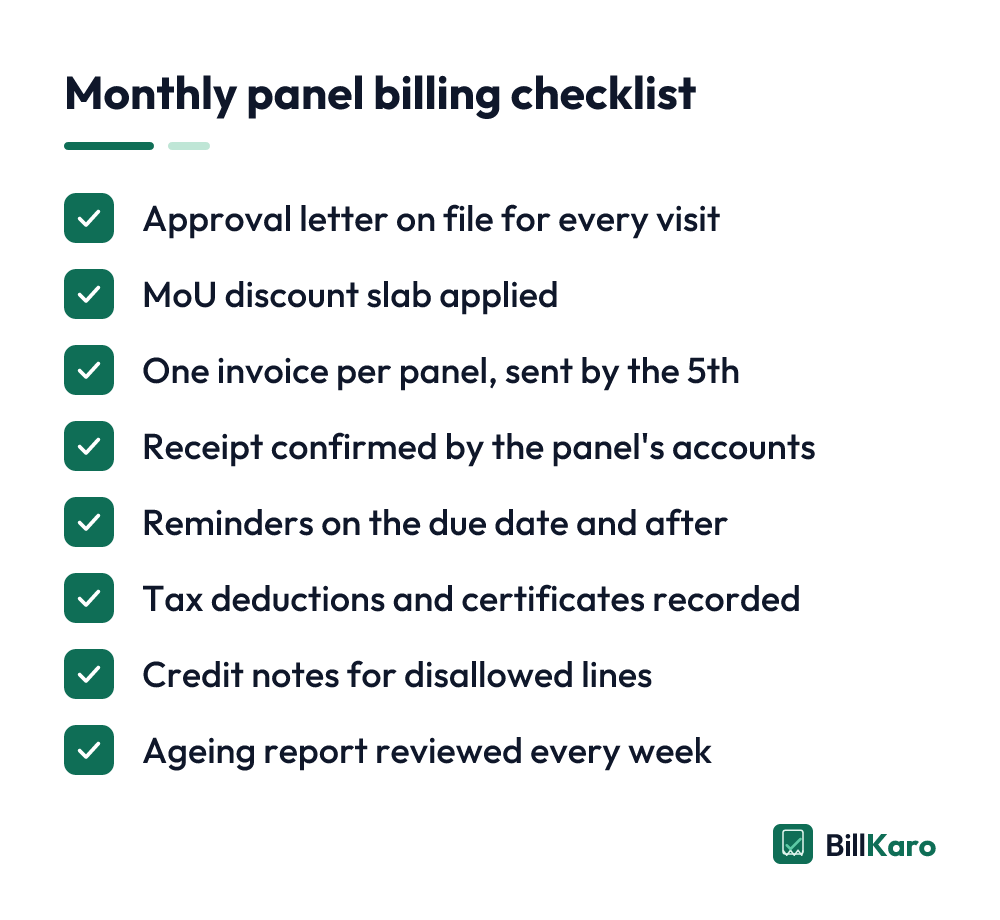
Attach copies of the approval letters and keep the originals filed by month. If a line has no approval, bill it separately or ask the patient to settle it, so one missing letter does not hold up the whole invoice.
For the fields every Pakistani invoice should carry, see our guide to invoice format in Pakistan.
How do you set up a panel billing routine that gets paid?
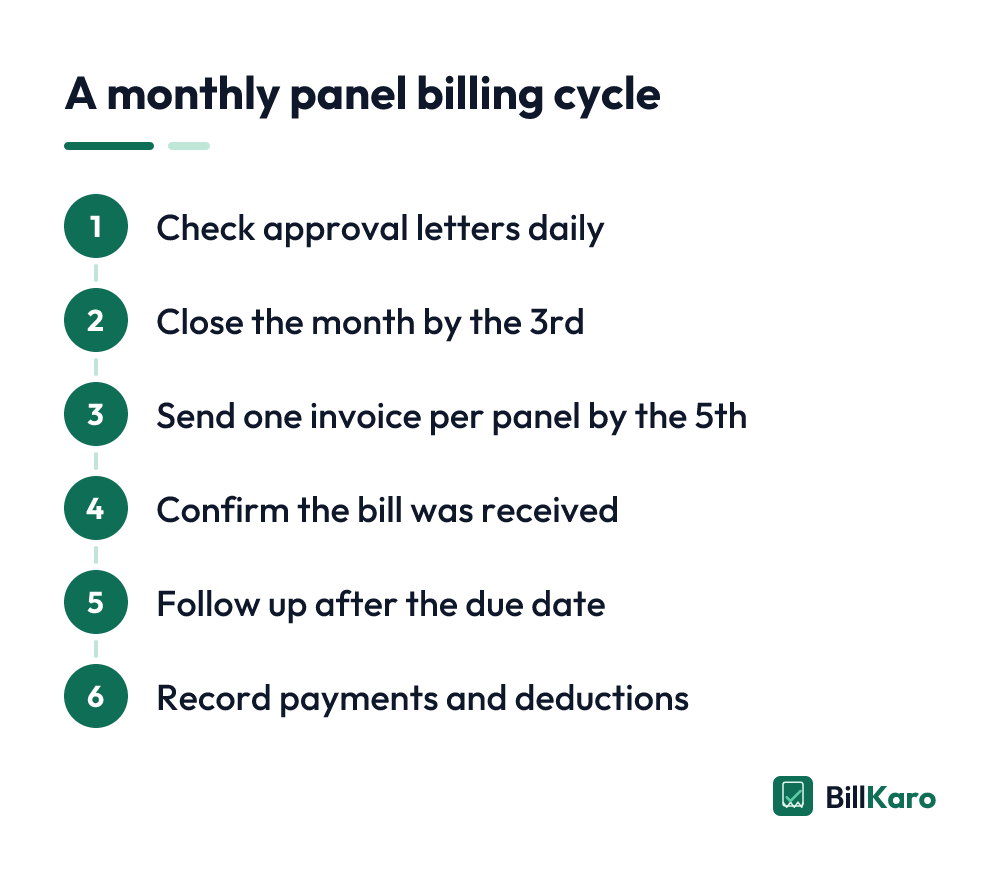
A panel billing routine gets paid when every month follows the same dates and every open invoice has an owner. Agree the credit period in the MoU, then run the same six steps each month:
- Check approvals daily. At the front desk or discharge, confirm each panel visit has its approval letter or reference before the patient leaves.
- Close the month by the 3rd. Freeze last month's panel visits, apply the MoU discount and fix any missing employee numbers.
- Send one invoice per panel by the 5th. Email the invoice and the patient-wise statement to the panel's accounts contact, not only to HR.
- Confirm receipt within a week. A short call or email asking whether the bill reached the right person saves a month of waiting.
- Follow up on set days after the due date. A reminder on the due date, another 15 days later, and a call to the finance manager at 30 days.
- Record every payment and deduction the day it arrives. Note the amount, reference, any tax deducted and any disallowed lines, so the invoice is either closed or shows exactly what is still owed.
Tip: Review your MoUs once a year. Add a clear credit period, the discount slabs, the approval rule and a named accounts contact. A panel agreement without a payment term is the main reason invoices drift past 90 days.
How should a hospital handle deductions and short payments?
A hospital should record every deduction against the invoice it belongs to, so a short payment never looks like an unpaid bill. Panel companies usually pay less than the invoice for one of three reasons, and each needs a different entry:
- Income tax deducted at source. Many companies deduct income tax when they pay for services and give a deduction certificate. The rates are set in FBR's withholding tax rate card for the tax year. Record the amount and keep the certificate, because it settles that part of the invoice and counts as a tax credit, not lost money.
- Disallowed lines. If the company refuses a medicine or service outside the package, issue a credit note for that line, or bill it to the patient, rather than leaving it as an old balance.
- Discount corrections. If the wrong slab was applied, correct it with a credit note and an explanation, so the next bill is right.
Then look at what is left. An ageing report sorts open panel invoices into current, 1-30, 31-60, 61-90 and over 90 days. Review it every week: anything past 60 days goes to the finance manager, and anything past 90 days goes back to the MoU and the person who signed it.
How can panel companies pay through 1Bill?
Panel companies can pay a hospital's invoice through 1Bill from their bank's mobile app or internet banking, instead of preparing a cheque or a manual bank transfer. 1Bill is 1LINK's bill payment service; 1LINK names utilities, telecom and ISPs, government bodies and education institutions among its billers, "including but not limited to" these (1LINK 1Bill).
BillKaro is a 1Bill payment-collection integration for Pakistani businesses: bills from your own system (by API or Excel/CSV upload) or from BillKaro's invoicing software can be paid through 1Bill from the customer's bank app or internet banking. When the panel company pays, the payment status syncs back, so the invoice is marked paid automatically and your team does not have to match a bank credit to the right bill.
A hospital can connect in one of three ways:
| Your situation | How it connects | Who issues the invoice |
|---|---|---|
| Your hospital system already produces panel bills | By API, so each bill can be paid through 1Bill | Your own system |
| Your bills come out of a system or spreadsheet as a file | Upload the month's bills as an Excel or CSV file | Your own system or sheet |
| You have no billing system for panels | Create the panels as clients in BillKaro | BillKaro's invoicing software |
The same works for patient bills. A hospital that already issues patient bills in its own system can send them to BillKaro by API or file, so patients can pay from their bank app too. Tech Vision Solvix is a 1LINK partner; 1LINK runs 1Bill. Read more in BillKaro and 1LINK, and see how bills are prepared in how to create a 1Bill invoice.
On cost, 1Bill collection through BillKaro has a one-time integration fee per business, which covers onboarding, the agreements and paperwork, and connecting your system (API or Excel/CSV upload) or setting up BillKaro. After that there is a charge per invoice paid through 1Bill, by the bill amount, and you decide whether to absorb it or pass it on. See the integration fee and the per-invoice prices on the pricing page.
What does BillKaro add to the panel billing desk?
BillKaro gives the panel desk a single record of what each organisation owes, from the first invoice to the last deduction. For hospitals without a billing system for panels, the invoicing software covers the routine above:
- Panel organisations as clients, with contact details, CC emails and NTN. A company with several offices can be a parent client with branch clients and receive one combined group invoice.
- Invoices with several line items, a discount, tax percentage, notes and terms, emailed with the PDF attached. Bulk invoicing creates many panel invoices at once.
- Full and partial payments recorded against each invoice, with the method and reference, plus receipt PDFs.
- Withholding tax entries that settle part of an invoice without counting as cash, with the certificate or CPR number stored and grouped by tax year.
- Credit notes for disallowed or corrected lines, applied fully or partly to invoices.
- Ageing, outstanding and overdue reports, plus a statement and ledger for each panel.
- Email reminders set by days after the due date, run automatically or by hand.
- A client portal where each panel company can see its invoices and download invoice and statement PDFs.
BillKaro handles billing and collection only. It is not hospital management software and does not keep patient records, appointments or prescriptions. For that side of a hospital or clinic, see the Tech Vision Solvix hospital and clinic system.
Frequently asked questions
What is panel billing in a hospital?
Panel billing is the way a hospital bills an employer, bank, government department or insurer for treatment given to that organisation's employees or dependants on credit. The patient shows an approval letter or card, and the hospital sends the organisation a monthly invoice under the terms of their agreement.
How often should a hospital bill its panel companies?
Most hospitals bill each panel once a month, early in the month, with a patient-wise statement. Monthly bills are smaller and easier for the company to check than quarterly ones, so they are approved and paid sooner.
Why do panel companies pay less than the invoice?
Usually because they deducted income tax at source, disallowed some items, or applied a different discount. Record the tax deduction with its certificate, issue a credit note for agreed corrections, and chase only the true balance.
Can a panel company pay a hospital invoice through 1Bill?
Yes, if the hospital collects through 1Bill. With BillKaro, the company pays from its bank's mobile app or internet banking, and the payment status syncs back so the invoice is marked paid automatically.
Can we keep our current hospital billing system?
Yes. Connect it to BillKaro by API, or upload the month's panel bills as an Excel or CSV file. Hospitals without a panel billing system can issue the invoices in BillKaro instead.
Panel money is earned the day the patient is treated; a fixed monthly routine makes sure it is also collected. To let your panel companies pay through 1Bill, see 1Bill invoices for business, or request a demo on WhatsApp and we will show you how to connect your panel bills.